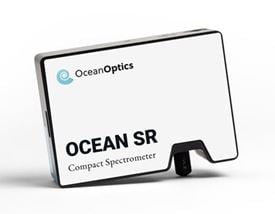
Ocean Optics SR Versatile Spectrometers are available in S2, S4, and S6 models, each of which offers high performance and broad spectral coverage to suit a diverse set of applications. SR2 spectrometers are optimized for fast spectral acquisition and high signal-to-noise ratio (SNR), making them ideal for applications such as laser characterization, plasma monitoring, and absorbance concentration. The SR4 spectrometers present superior thermal wavelength stability, low-noise CCD detection, and consistent high signal-to-noise performance, perfect for plasma monitoring and reflection measurements. High-sensitivity SR6 models provide exceptional SNR and UV response, supporting applications such as UV absorbance, fluorescence, and plasma diagnostics. The Ocean Optics SR Versatile Spectrometers include the user-friendly OceanView software system to optimize spectrometer performance, ease system integration, and access data for analysis.
| Series | Manual | Model Number | EO PN | λ Range (nm) | Resolution in nm @ Slit Size | |||||
|---|---|---|---|---|---|---|---|---|---|---|
| 5um | 10um | 25um | 50um | 100um | 200um | |||||
| ST | ST Manual | ST-NIR-25 | #90-014 | 645 – 1085 | N/A | N/A | 2.2 | N/A | N/A | N/A |
| ST | ST Manual | ST-UV-25 | #90-015 | 185 – 650 | N/A | N/A | 2.2 | N/A | N/A | N/A |
| ST | ST Manual | ST-VIS-25 | #90-016 | 350 – 810 | N/A | N/A | 2.2 | N/A | N/A | N/A |
| SR2 | SR Manual | SR-2N750-25 | #90-017 | 570 – 860 | 0.54 | 0.61 | 0.84 | 1.33 | 2.36 | 4.34 |
| SR2 | SR Manual | SR-2UVV300-25 | #90-018 | 195 – 850 | 0.86 | 1.01 | 1.33 | 2.06 | 3.8 | 7.61 |
| SR2 | SR Manual | SR-2VN500-25 | #90-019 | 350 – 1040 | 0.86 | 1.02 | 1.34 | 2.08 | 3.83 | 7.66 |
| SR4 | SR Manual | SR-4UVV300-25 | #90-020 | 190 – 910 | 1.17 | 1.25 | 1.65 | 2.55 | 4.62 | 9.24 |
| SR4 | SR Manual | SR-4VN500-25 | #90-021 | 350 – 1040 | 1.17 | 1.25 | 1.65 | 2.55 | 4.62 | 9.24 |
| SR6 | SR Manual | SR-6UVV300-25 | #90-022 | 180 – 900 | 1.17 | 1.25 | 1.64 | 2.54 | 4.68 | 9.36 |
| SR6 | SR Manual | SR-6VN500-25 | #90-023 | 350 – 1040 | 1.17 | 1.25 | 1.64 | 2.54 | 4.68 | 9.36 |
| HR2 | HR Manual | HR-2N750-25 | #90-024 | 750 – 900 | 0.16 | 0.2 | 0.24 | 0.462 | 0.88 | 1.68 |
| HR2 | HR Manual | HR-2UVV300-25 | #90-025 | 200 – 650 | 0.35 | 0.46 | 0.58 | 0.97 | 1.84 | 3.52 |
| HR2 | HR Manual | HR-2VIS500-25 | #90-026 | 400 – 850 | 0.41 | 0.53 | 0.57 | 0.99 | 1.73 | 3.34 |
| HR2 | HR Manual | HR-2XR500-25 | #91-559 | 190 – 1100 | 0.71 | 0.84 | 1.13 | 1.97 | 3.76 | 7.19 |
| HR4 | HR Manual | HR-4UVV300-25 | #90-027 | 200 – 660 | 0.26 | 0.48 | 0.57 | 0.96 | 1.82 | 3.48 |
| HR4 | HR Manual | HR-4VIS500-25 | #90-028 | 400 – 850 | 0.26 | 0.48 | 0.57 | 0.96 | 1.82 | 3.48 |
| HR4 | HR Manual | HR-4XR500-25 | #91-560 | 190 – 1100 | 0.54 | 0.8 | 1 | 2 | 3.78 | 7.24 |
| HR6 | HR Manual | HR-6VIS500-25 | #90-029 | 400 – 840 | 0.35 | 0.46 | 0.58 | 0.97 | 1.84 | 3.54 |
| HR6 | HR Manual | HR-6UVV300-25 | #90-030 | 200 – 650 | 0.35 | 0.46 | 0.58 | 0.97 | 1.84 | 3.54 |
| HR6 | HR Manual | HR-6XR500-25 | #91-561 | 190 – 1100 | 0.71 | 0.94 | 1.18 | 1.97 | 3.76 | 7.24 |
| QEPRO | QEPRO Manual | QEPRO-N750-25 | #90-732 | 640 – 810 | 0.4 | 0.44 | 0.52 | 0.66 | 0.94 | 1.78 |
| QEPRO | QEPRO Manual | QEPRO-UVV300-25 | #90-733 | 220 – 650 | 0.8 | 0.88 | 1.04 | 1.32 | 1.88 | 3.56 |
| NR1.7 | NR Manual | NR-512-1.7-25 | #90-951 | 900 – 1650 | n/a | 2.72 | 2.85 | 4.02 | 6.71 | 13.03 |
| NR2.2 | NR Manual | NR-512-2.2-25 | #90-952 | 900 – 2190 | n/a | 3.12 | 4.8 | 5.52 | 10.08 | 18.96 |
| NR2.5 | NR Manual | NR-512-2.5-25 | #90-953 | 900 – 2450 | n/a | 4.21 | 6.5 | 7.45 | 13.6 | 29.59 |
The interchangeable design of OO spectrometers allows users to easily swap different slit sizes, which historically could only be done by sending them to the manufacturer. This makes it easier to find the most efficient configuration for your application. While there are benefits to decreasing the slit width, there are also drawbacks. The main benefit is that resolution is increased when the slit size decreases. This can be essential when precise measurements are needed. On the contrary, as the slit size decreases, light throughput also decreases leading to longer acquisition times. This would not be ideal for applications where speed is a factor. When changing the slit size from the given 25um one, it is also important to note that this can slightly skew wavleength calibration, but the affects would be minimal.
Overall, selecting the best slit size for an application is a balancing act of the required speed and resolution. It is recommended to purchase the slit kit if it is unclear which slit size would be best for an application.

| Ocean Optics Illumination Options | |||||
|---|---|---|---|---|---|
| Type | Model (Spectral output found in link) |
λ Range (nm) | Fiber Connector | User Manual | EO PN |
| Deuterium-Tungsten Illuminator | DH-2000-BAL | 210 - 2500 | SMA 905 | DH-2000 | #90-546 |
| Xenon Illuminator | HPX-2000 | 185 - 2500 | SMA 905 | HPX-2000 | #90-545 |
| Tungsten-Halogen Illuminator | HL-2000-LL-FHSA | 360 - 2400 | SMA 905 | HL-2000 | #90-544 |
or view regional numbers
QUOTE TOOL
enter stock numbers to begin
Copyright 2024, Edmund Optics Singapore Pte. Ltd, 18 Woodlands Loop #04-00, Singapore 738100
California Consumer Privacy Acts (CCPA): Do Not Sell or Share My Personal Information
California Transparency in Supply Chains Act
This content may include material that has been generated or modified using artificial intelligence (AI).
The FUTURE Depends On Optics®